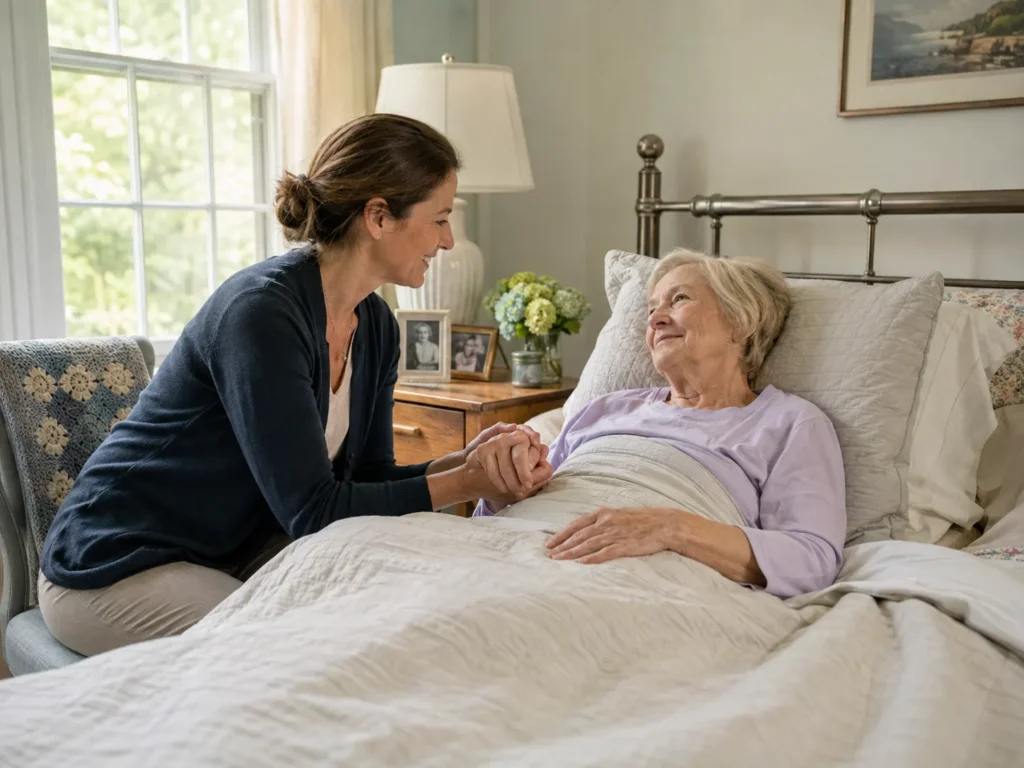
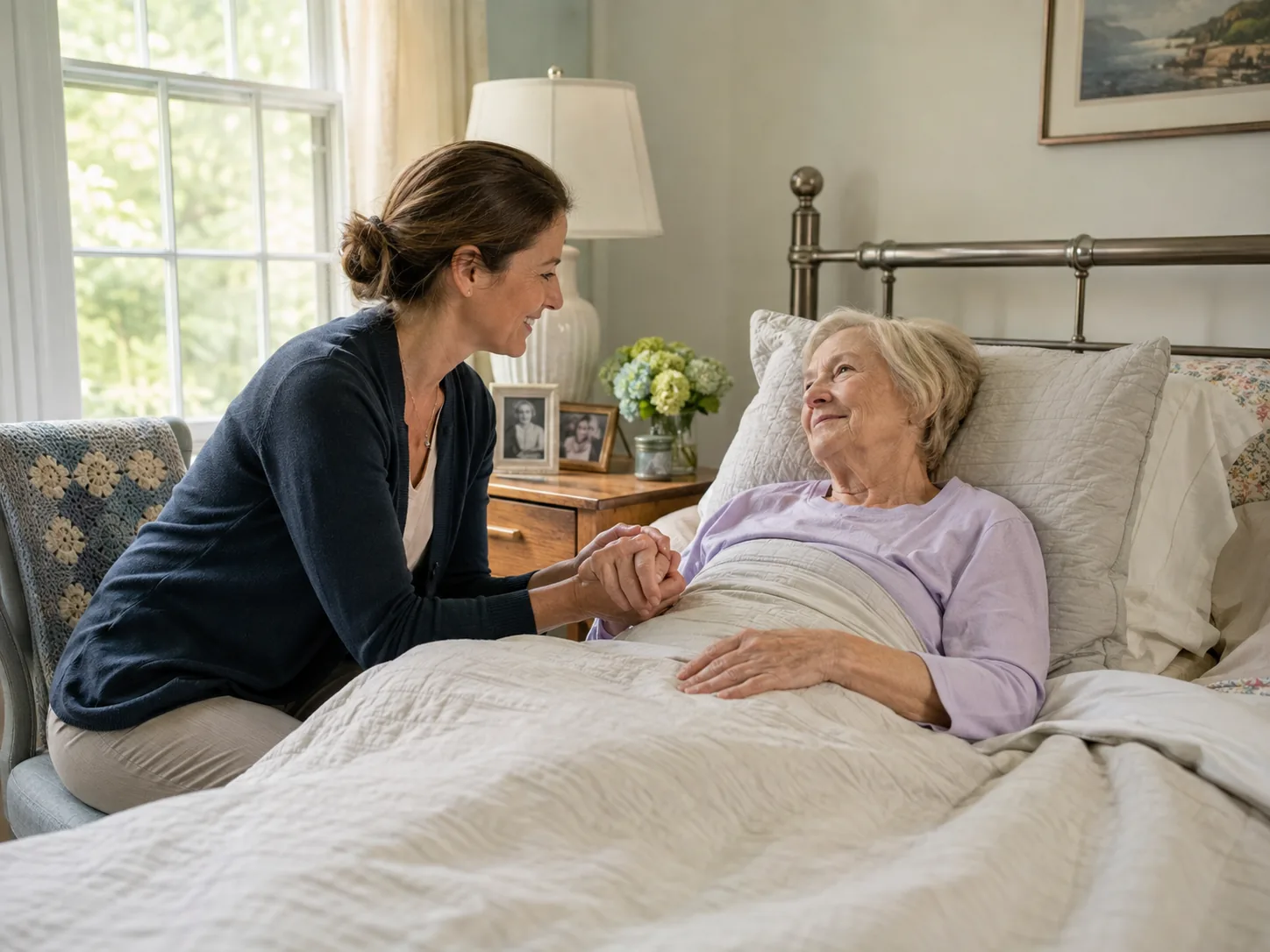
MF Family Home Care provides senior home care on Cape Cod: non-medical help that lets an older adult keep living in their own house. This page explains what home care covers, how to work out how much help is needed and what the first weeks look like.
Senior home care is the general name for help that lets an older person stay in their own house. It can be two visits a week or someone there around the clock, and it changes as the person does.
Home care is a set of services, used in whatever combination the household needs.

Bathing, dressing, toileting and help moving around the house safely.

Company, errands, appointments and getting out of the house.

Cleaning, laundry, shopping and cooking.

Medication prompts, meals at regular times and a steady daily structure.

Overnight stays, live-in arrangements and relief for a family caregiver.

Look at four things before choosing hours.

Can your parent get in and out of the shower and on and off the toilet without holding on to something that could give way?

Is there fresh food in the house, and are regular meals being eaten?

How long is your parent by themselves each day, and what would happen after a fall during that time?
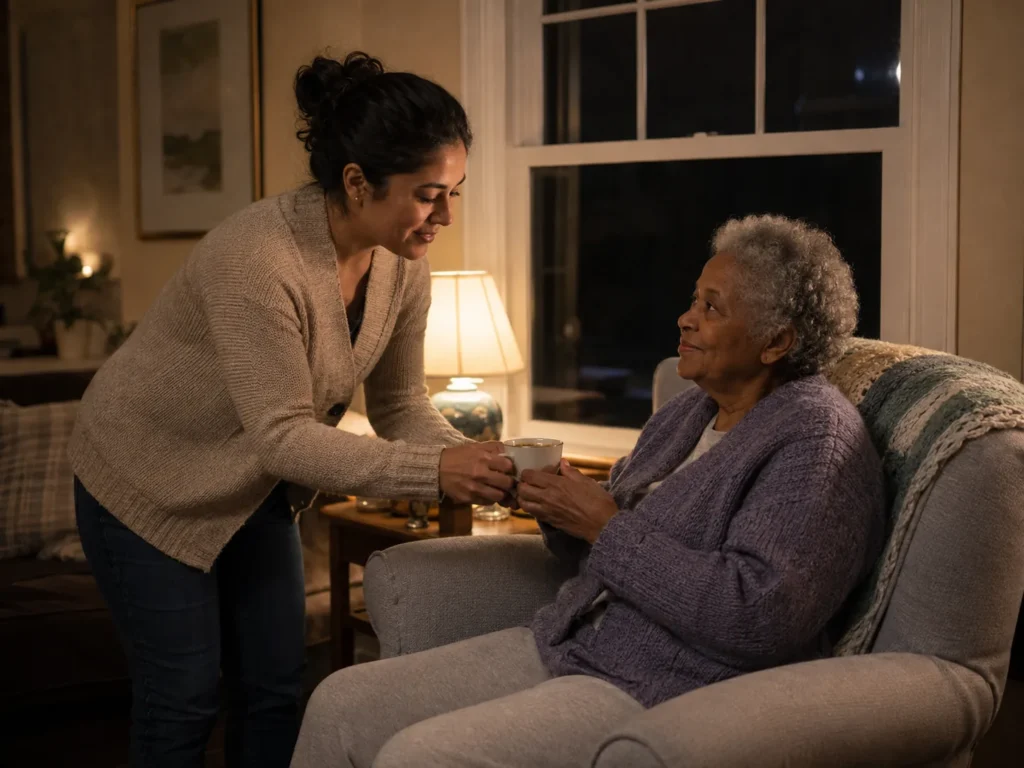
Changes tend to be gradual. Compare today with six months ago: weight loss, unopened mail, missed appointments, new dents on the car, the same clothes several days running, a house that is less clean than it used to be, or a parent who has stopped going out.
One of these alone may mean little. Several together usually mean that daily tasks have become difficult and are being quietly dropped.
Families often use these terms interchangeably, and they are different things. Home care is non-medical help with daily life, hired privately for as long as needed. Home health care is medical: nursing or therapy at home for a limited time, ordered by a doctor and usually covered by Medicare. Assisted living means moving to a residence where meals, housekeeping and some personal care are provided.
We provide home care. We do not provide skilled nursing or hospice, and we do not bill Medicare. Many of our clients also have a home health nurse or therapist coming in, and the two fit together well.
Non-medical home care for seniors covers daily life: washing, meals, housework, company and getting to appointments. Nursing and therapy belong to home health care, which a doctor orders and Medicare may pay for.
It starts with a phone call and a free visit to the house. We meet your parent, see how they move, look at the bathroom and kitchen, and ask about the daily routine. From that we suggest a schedule.
Most families begin with a few visits a week and adjust after seeing how it goes. The first visits are partly about getting acquainted; a parent who was reluctant often relaxes once the visits become familiar.
Home care is billed by the hour, and the rate depends on the kind of help: companion and homemaker visits cost less than hands-on personal care. Overnight and live-in arrangements are quoted separately.
Medicare does not pay for non-medical home care. We accept long-term care insurance. Veterans and surviving spouses may qualify for VA Aid and Attendance. For older adults with limited income, the Massachusetts Home Care Program offers subsidized help through Elder Services of Cape Cod and the Islands.
MF Family Home Care is based at 21 College Road in West Yarmouth and is owned by Marlene Plouf, a Certified Nurse Aide registered with the Massachusetts Department of Public Health (CNA54796). The business is insured, and care is available in English, Portuguese and Spanish.
You can read what client families have written in the Google reviews further down this page.
Care is arranged from West Yarmouth. Each town below has its own page.
Marlene is very caring, trustworthy, and attentive. She takes excellent care of my father, and I highly recommend MF Family Home Care.
I highly recommend her caregiving services. She is kind, compassionate, reliable, and truly cares about the well-being of her clients. She is patient, attentive, and always goes above and beyond to make sure people feel safe, comfortable, and respected.
Marlene is an excellent and responsible caregiver for my sister. She is thoughtful and kind. I would recommend her highly to anyone who has a wheelchair bound relative who simultaneously has Alzheimer’s disease.
Call at any hour. Describe what has changed and we will tell you what kind of help fits, including when home care is not the right answer.
The questions that come up on most first calls.
It is charged by the hour, and the weekly total depends on the hours and the type of help. Call with a rough schedule and we will give you a figure for your situation.
Medicare pays for medical home health care ordered by a doctor for a limited period. It does not pay for non-medical home care such as help with bathing, meals and housekeeping when that is all that is needed.
Often between six and twelve hours a week, spread over two or three visits. Needs after a hospital stay or with dementia are usually higher.
Yes. The consultation at home costs nothing and does not commit you to starting care.
It depends on how many hours of help are needed and on whether your parent wants to stay in the house. For a few hours a day, home care generally costs less and avoids a move. When care is needed around the clock, the comparison changes and is worth doing carefully.
Yes. If what your parent needs is medical care, a rehabilitation stay or a memory care residence, we will say so on the first call.
For someone who needs help with daily life but not nursing around the clock, home care lets them stay where they are comfortable. A nursing home is for people who need skilled nursing day and night. The doctor can tell you which level of care your parent needs.
Last updated