
Home • Blog • Deciding on care
Home Care vs. Home Health Care: What’s the Difference?

Home care is non-medical help with daily life: bathing, dressing, meals, getting around the house safely, and company. Home health care is medical care at home, ordered by a doctor and delivered by nurses or therapists. The names differ by one word, but who provides each one, who pays for it, and how long it lasts are completely different.
Families confuse the two all the time, and it is not their fault. A discharge planner can use both terms in the same sentence. Ads use them loosely. And the person who needs help often needs a bit of each, at different moments.
Below is how to tell them apart, and how to work out which one your parent needs right now.
Home care vs. home health care at a glance
| Home care | Home health care | |
|---|---|---|
| What it is | Help with everyday living | Skilled medical care at home |
| Who decides | The family | A doctor, through a plan of care |
| Who provides it | Caregivers and companions, often certified nurse aides | Registered nurses and physical, occupational or speech therapists |
| Typical tasks | Bathing, dressing, meals, light housekeeping, errands, medication reminders, company | Wound care, injections, monitoring after surgery, rehabilitation exercises |
| Length of a visit | A few hours, set by the family | Usually under an hour |
| How long it lasts | Weeks, months or years | A set number of visits, often a few weeks |
| Who usually pays | The family, long-term care insurance, some veterans’ and state programs | Medicare, Medicaid or health insurance, when the criteria are met |
What home care covers
Home care goes by several names: non-medical home care, private-duty care, in-home care. All of them describe the same thing: help with the parts of the day that have become hard or unsafe to do alone.
It falls into two groups.
Personal care is hands-on help with the body: bathing and showering, dressing, toileting, grooming, and moving safely from the bed to a chair or from the chair to the bathroom. This is the help most parents find hardest to accept and most families find hardest to provide themselves. Personal care at home exists for exactly this.

Companion and household help covers everything around the body: cooking and eating together, light housekeeping, laundry, grocery runs, rides to appointments, reminders to take medication on time, and conversation. For a parent who should not be alone all day, the company is often the main point. More on companion care.
What home care does not include: injections, dressing wounds, changing medication doses, or any task that needs a nurse’s license. A good home care provider tells you plainly where that line sits, before you have to ask.
What home health care covers
Home health care is medical. A doctor certifies that your parent needs skilled care and signs a plan of care. A home health agency then sends a registered nurse, a physical therapist, an occupational therapist or a speech therapist on scheduled visits.
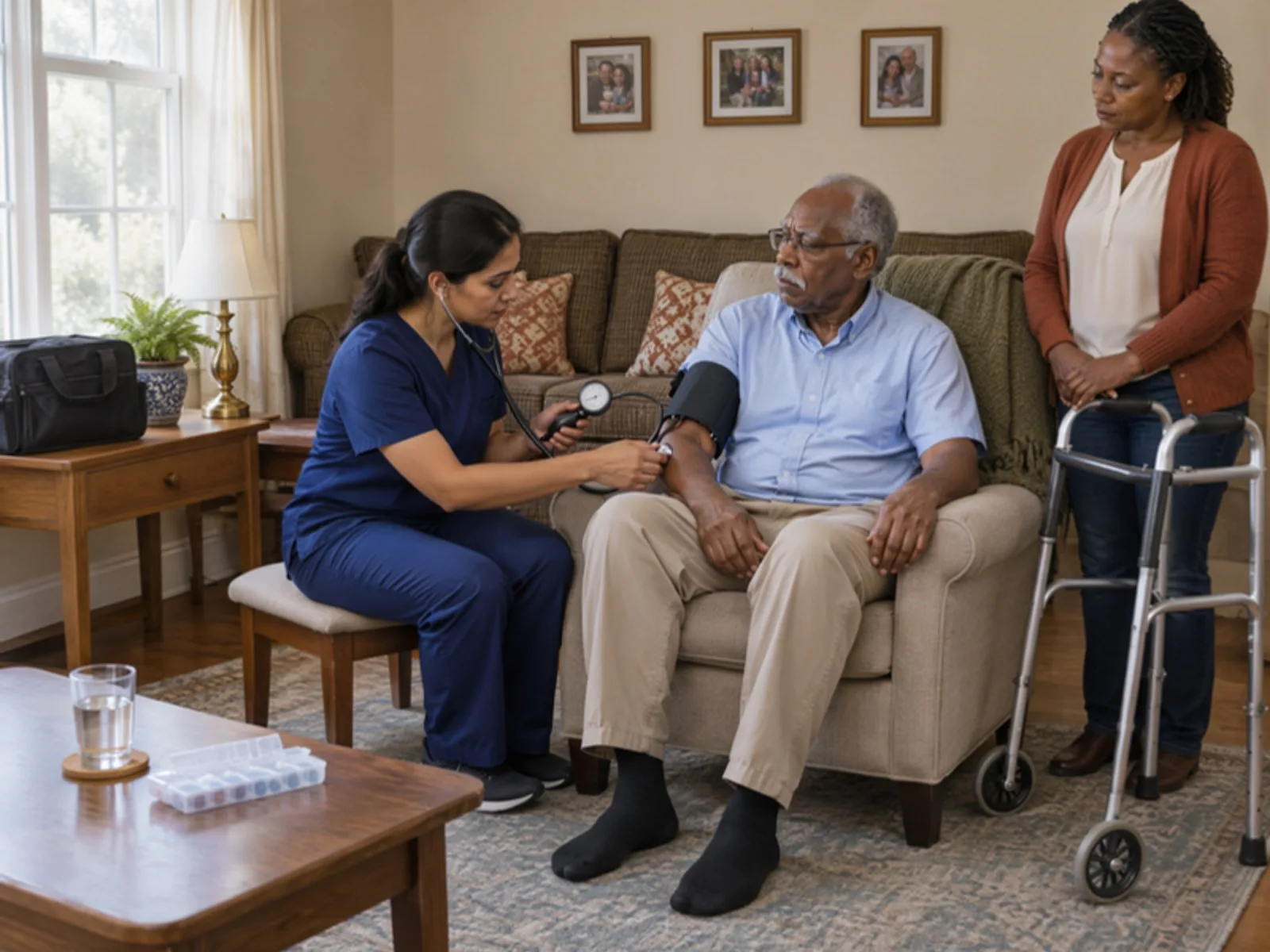
It usually starts after a hospital stay, a surgery, a new diagnosis, or a chronic condition that has suddenly become harder to manage. The goal is recovery or stability, and once that goal is met, the visits end.
The visits are short and spread out. A nurse may come twice a week for forty minutes to check a wound and review medications. A therapist may come three times a week to work on walking. Between visits, nobody from the agency stays to help with the shower or lunch, and that gap is where most families get caught.
Does Medicare pay for home care?
Usually not, when non-medical help is the only thing your parent needs.
Medicare Part A and Part B cover home health care when all of these are true, according to Medicare’s own coverage rules:
- Your parent is under a doctor’s care, with a plan of care the doctor reviews regularly.
- A doctor certifies that they need part-time nursing care from a registered nurse, physical therapy or speech therapy, or continued occupational therapy.
- They are homebound, meaning leaving the house takes considerable effort.
- The agency is Medicare-certified.
Medicare does not pay for round-the-clock care at home, for meals delivered, for shopping and cleaning on their own, or for personal care such as bathing and dressing when that is the only care needed.
So families pay for home care in other ways:
- Privately, which is how most home care is paid for.
- Long-term care insurance, if your parent has a policy. Read the home care benefit and the waiting period before the first visit, not after.
- Veterans’ benefits, for veterans and surviving spouses who qualify. See home care for veterans.
- Massachusetts state programs for older adults, run through local Aging Services Access Points. On Cape Cod that is Elder Services of Cape Cod and the Islands, which can assess whether your parent qualifies.
What “licensed” and “certified” mean in Massachusetts
These words get used loosely, so it helps to know what each one actually refers to.
A home health agency that bills Medicare has to be Medicare-certified and is inspected against federal standards. That is the paperwork behind the nurse who visits after surgery.
Non-medical home care in Massachusetts does not currently require a state agency license. That means quality varies more than families expect, and it is worth asking any provider who will actually come to the house, what training that person has, and what happens if they are sick.
A Certified Nurse Aide (CNA) is a person, not an agency. A CNA has completed state-approved training, passed a competency exam, and is listed on the Massachusetts Nurse Aide Registry. The certification does not turn home care into medical care. What it gives you is someone trained in safe transfers, infection control, and noticing early when something about your parent has changed.
Companion care vs. personal care
Inside home care there are two levels, and the difference is touch.
Companion care is help without hands-on body care. A companion caregiver cooks, keeps the house in order, drives to appointments, plays cards, takes a walk, makes sure the pills on the counter were taken, and is simply there for a parent who should not spend the whole day alone.
Personal care adds the hands-on part: getting in and out of the shower, dressing, using the toilet, moving from one room to another without a fall.
Many parents start with companion care a few afternoons a week and add personal care later, when bathing becomes the hard part. Starting small also makes the second step easier to accept, because by then the person helping is someone your parent already knows.
Which one does your parent need?
Four questions sort out most situations:
- Does any task need a nurse or a therapist? Wound care, injections, physical therapy after a fall. If yes, that part is home health care, and the doctor or the hospital arranges it.
- Has a doctor ordered it? Home health care starts with a doctor’s order. Home care does not need one; the family decides.
- Is the struggle with daily life rather than a medical task? Meals, bathing, the mail, days spent alone. That is home care. If you are not sure yet, these 9 signs an elderly parent needs help at home are a good place to start.
- Will the need end in a few weeks, or keep going? Home health care is built to end. Home care is built to continue for as long as it helps.
Often the answer is both. A parent comes home from the hospital with a nurse visiting twice a week, and still needs someone for the shower on Wednesday and lunch every day. In that case the two work side by side: home health handles the medical visits, home care covers the hours in between. Keep the nurse’s notes and the medication list where the home care caregiver can see them, so nothing falls through the gap. The first weeks after a hospital discharge are when this matters most.
Frequently asked questions
Is home care the same as home health care?
No. Home care is non-medical help with daily living, such as bathing, meals and company, and the family arranges it. Home health care is medical care, such as nursing and therapy, that a doctor orders and that usually lasts a few weeks.
Do I need a doctor’s order for home care?
No. Non-medical home care does not need a doctor’s order. Home health care does, because it is medical care that Medicare and insurance only pay for under a doctor’s plan of care.
Can a home care caregiver give medication?
A home care caregiver can remind your parent to take medication and help keep the routine on track. Injections, dose changes and other medical tasks belong to a nurse, which means home health care.
Can my parent have home care and home health care at the same time?
Yes, and it is common after a hospital stay. The home health nurse or therapist handles the medical visits, and home care covers daily needs in the hours between them.

Owner of MF Family Home Care and a Certified Nurse Aide registered with the Massachusetts Department of Public Health. She provides non-medical home care to older adults across Cape Cod.
Home care on Cape Cod
MF Family Home Care provides non-medical home care across Cape Cod, including Yarmouth, Dennis, Barnstable and Hyannis, Harwich, Brewster, Chatham, Orleans, Mashpee, Sandwich, Bourne and Falmouth.
I am Marlene Plouf, the owner, and a Certified Nurse Aide registered with the state of Massachusetts (CNA54796). MF does not provide medical care. If your parent needs a nurse, I will tell you so and point you toward a home health agency, and home care can run alongside it.
If you are trying to decide which kind of help fits, a phone call usually settles it faster than another week of reading. Call (781) 243-9736, or see how home care on Cape Cod starts.